
Edmonton winter moving guide
Moving in Edmonton in Winter: A Practical Guide
Moving in Edmonton in winter is workable, but it plays by different rules: parking bans after heavy snow, about seven and a half hours of daylight in late December, and cold that is hard on electronics, liquids and pianos. This guide covers each with its source, then the best time of year to move and a checklist.
Last reviewed: September 2026
- Local Edmonton crews
- Founded in Ottawa in 2010
- Written quote before move day
- Sources linked
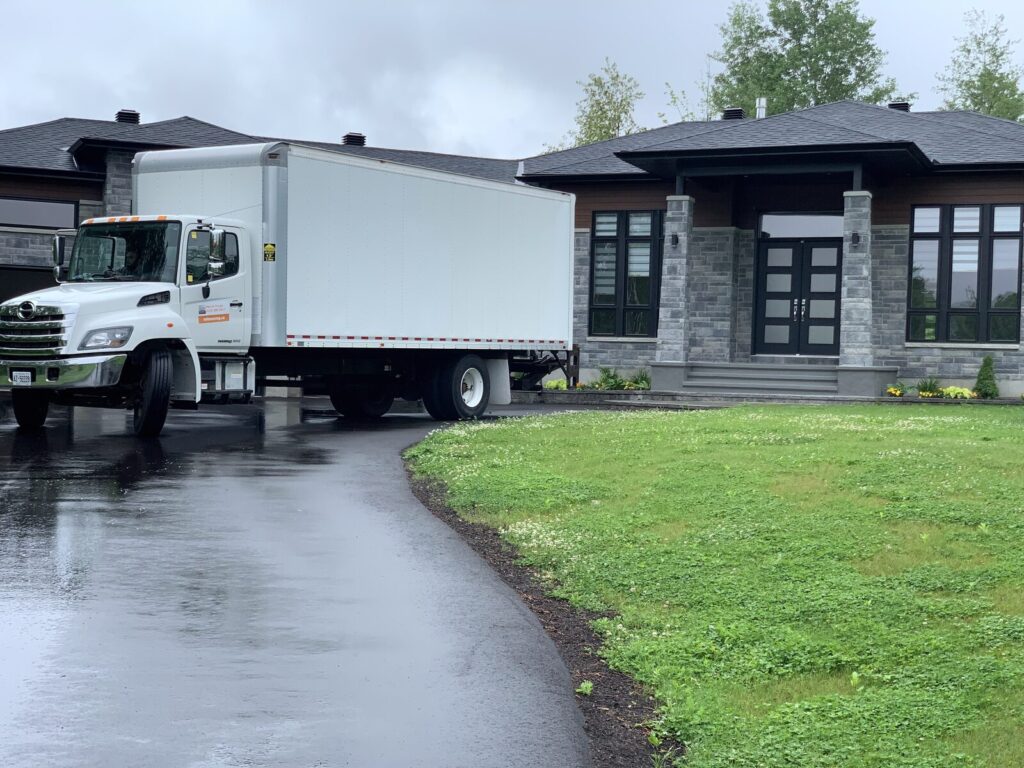
Men In Trucks truck (photographed in Ottawa).
Moving in Edmonton in winter, by the numbers
At the airport weather station, at least 1 cm of snow covers the ground on about 141 days a year, wind chill drops below −20 on about 65, and freezing rain or drizzle falls on about 7, mostly from November to February.
| Month | Average high | Average low | Snowfall | Days with a low below −20 °C |
|---|---|---|---|---|
| November | −0.1 °C | −10.6 °C | 17.3 cm | 3.3 |
| December | −5.5 °C | −16.5 °C | 15.9 cm | 9.7 |
| January | −6.3 °C | −17.7 °C | 21.7 cm | 10.9 |
| February | −3.8 °C | −15.9 °C | 13.4 cm | 8.3 |
| March | 1.2 °C | −10.0 °C | 17.5 cm | 4.1 |
Source: Environment and Climate Change Canada climate normals, 1981–2010, Edmonton International Airport station. The city centre runs slightly warmer: its January mean is about −10.4 °C, against −12.1 °C at the airport.
March averages more snow than December.
Parking bans and where the truck can stop
The most Edmonton-specific winter issue is the seasonal parking ban. After heavy snowfall the City can declare one with at least 8 hours' notice, in two phases (City of Edmonton):
Phase 1: major roadways
Arterial and collector roads, Business Improvement Area roads and bus routes: no parking 24 hours a day for 3–4 days where white "Seasonal No Parking" signs are posted.
Phase 2: residential streets
All residential and industrial areas. Each neighbourhood is affected for about 72 hours, with at least 24 hours' notice and yellow "No Parking" signs at its entrances.
Alleys are off limits during both phases. Parking on a road under a ban carries a 250-dollar fine, and so does leaving objects that obstruct clearing, such as an unattached trailer or a commercial dumpster, in the right-of-way.
- Check the City's snow clearing map and schedule, or call 311, the day before and that morning.
- Keep your driveway clear, and tell us whether a truck can use it or a loading area (alleys are off limits while a ban is on).
- Skip the front lawn: the Zoning Bylaw forbids parking on a landscaped front yard.
Edmonton's Traffic Bylaw lets commercial vehicles stop to load and unload with hazard lights on. We plan the truck position before move day. That does not override a declared ban, posted no-stopping zones, Residential Parking Program restrictions or the alley rule. Nearby municipalities such as St. Albert and Strathcona County set their own rules, so check with them.
Tell us about the access. Driveway, steps, the carry to the curb and building rules shape a winter move, and they all go into your written quote.
Paths, steps and floors
The riskiest few metres of a winter move are often between the door and the truck.
Outside: a clear, wide path
- Shovel the whole route the evening before, wide enough for furniture and its carriers, and clear any plow ridge.
- Residential streets are bladed to about 5 cm of snowpack, not bare pavement, so expect packed snow where the truck stops.
- Spread ice melt or sand on steps and slopes that night and again in the morning.
- Switch on the outside lights, since some carrying may happen in the dark.
- In a condo, ask whether the loading entrance will be cleared; see our notes on elevator-building moves.
Inside: salt and slush off the floors
Road salt can mark hardwood, and meltwater makes tile slippery. Runners along the route, mats or old towels at each door, and doors closed between trips keep floors dry and the heat in.
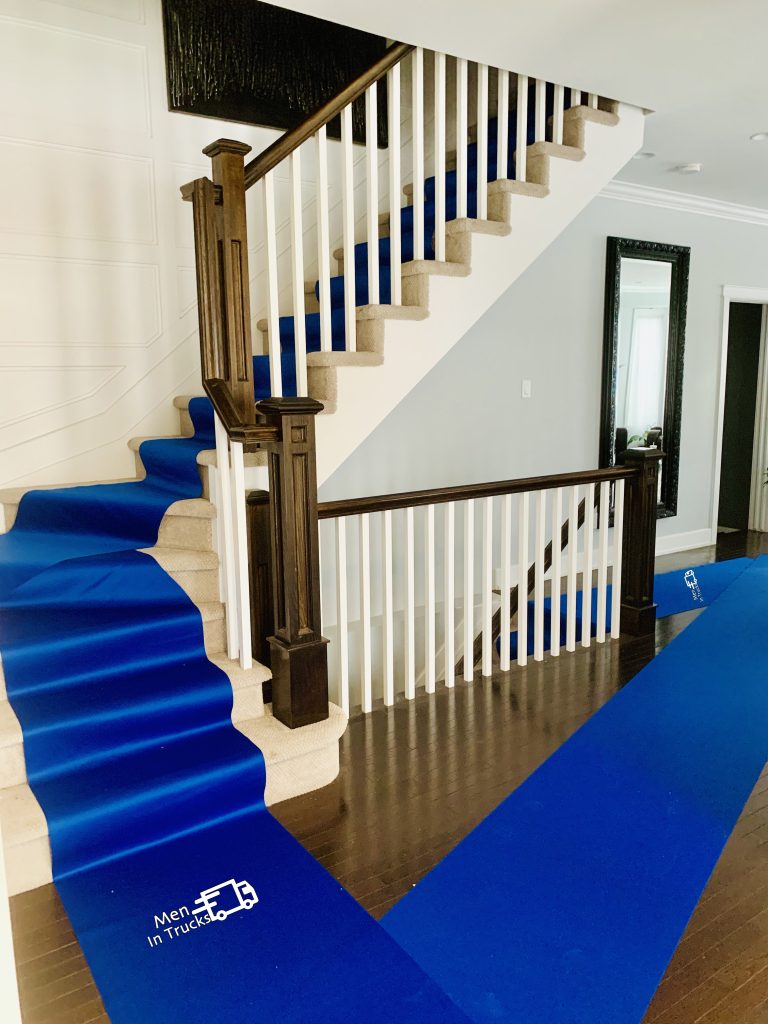
Floor runners protecting a staircase and hallway (photographed in Ottawa).
More family-home planning: house moves in Edmonton.
Cold-sensitive items: what rides in your heated car
The cargo area of most moving trucks is not heated, so anything that can freeze, crack or collect condensation should ride with you.
| Item | What the cold can do | What to do |
|---|---|---|
| TVs, computers, consoles | Moisture can condense inside when they come into a warm room. | Keep them wrapped; switch on only at room temperature. |
| Laptops, phones, hard drives | Batteries drain faster, and data is hard to replace. | Carry them with you. |
| Liquids and houseplants | Liquids can freeze and split containers; brief exposure to freezing air can damage plants. | Move them in your heated vehicle. |
| Pianos and wooden instruments | Swings in temperature and humidity stress wood and strings. | Ask for it to be loaded last and unloaded first, and play it only once it has reached room temperature. |
| Washer hoses, fridge water lines | Leftover water can freeze. | Drain them first, following the manual. |
Medication, documents, keys and pets always travel with you. If you book professional packing, flag cold-sensitive items; for pianos, see moving a piano in Edmonton.
Daylight: plan around a short day
Around the solstice Edmonton gets under eight hours of daylight, less than half of what it gets in late June.
| Date | Sunrise | Sunset | Daylight |
|---|---|---|---|
| December 1 | 9:27 a.m. | 5:18 p.m. | 7 h 51 min |
| December 21 | 9:48 a.m. | 5:16 p.m. | 7 h 28 min |
| June 21 | 5:04 a.m. | 10:07 p.m. | 17 h 03 min |
Source: timeanddate.com Edmonton sun tables for 2026.
Do the wrapping and disassembly in the dark, and save icy steps and long outdoor carries for daylight. Allow extra time for the drive: darkness, snow and rush hour slow traffic, and the river crossings are choke points between north-side and south-side neighbourhoods.
Moving west in winter: BC mountain rules
A winter move west to Kamloops, Kelowna or the coast crosses the mountains on the Yellowhead (Hwy 16) through Jasper or the Trans-Canada through Rogers Pass. Winter tires or chains are required on most BC routes from October 1 to April 30; some routes outside mountain passes end March 31 (Government of British Columbia). Check DriveBC and 511 Alberta before you travel; the rules apply to your own car too. Your written quote states the pickup date and the delivery window. More on moving from Edmonton to Vancouver.
The best time of year to move in Edmonton
Here is how the seasons trade off:
| Season | Weather and light | Plan around |
|---|---|---|
| Winter (Dec–Feb) | Coldest months; January lows average about −17.7 °C. | Parking bans, ice, cold and short days. |
| Spring (Mar–May) | About 17.5 cm of snow in March and 14.4 cm in April; the last spring frost comes around May 24 on average. | Freeze-thaw ice and slush; protect plants until the last frost. |
| Summer (Jun–Aug) | Warmest months, with about 17 hours of daylight on June 21. | July is the wettest month on average, with about 9.5 thunderstorm days. |
| Fall (Sep–Oct) | September highs average about 17 °C; the first fall frost comes around September 12 on average. | October averages about 10 cm of snow. |
Student moves around the U of A tend to cluster at term boundaries: late April after winter exams, and late August into early September (see the University of Alberta calendar for term dates).
With flexible dates, late May to mid-September is the easiest stretch for weather; with fixed dates, winter works with the preparation on this page. Price is a separate question from weather; see how moving prices are built in Edmonton.
Winter moving-day checklist
Use these Edmonton winter moving tips as a timeline, starting a week out.
The week before
- Find your street on the City's Residential Snow Clearing Schedule.
- Confirm heat at the new home; book elevators at both buildings.
- Pack a heated-car tub: electronics, liquids, plants, medication, documents.
The night before
- Shovel and salt the route, including the plow ridge.
- Drain washer hoses and the fridge water line; test outside lights.
- Check the ban status; move cars off the street and driveway.
Moving morning
- Re-check the ban and re-salt anything that froze.
- Lay mats and runners; keep pets and children in a warm, closed room.
At the new home
- Clear the path and lay runners first; let electronics and any piano warm up before use.
Men In Trucks Moving Inc. has moved families and businesses since 2010 in Ottawa and has now launched in Edmonton with local crews. To hand some of this over, tell us about your move, or browse our Edmonton moving services.
Winter moving questions
Is it a bad idea to move in Edmonton in winter?
No, but it takes more planning than a summer move. January lows average about −17.7 °C at Edmonton International Airport, a parking ban can limit where a truck stops, and late December has only about seven and a half hours of daylight. Clear and salt the path, check the City's ban status the day before and that morning, and keep cold-sensitive items in a heated car.
What happens if a parking ban is declared on moving day?
The City of Edmonton gives at least 8 hours' notice. Phase 1 bans parking around the clock on signed major roads and bus routes; Phase 2 covers residential and industrial areas on a schedule, with each neighbourhood affected for about 72 hours and at least 24 hours' notice, and alleys are off limits in both. A vehicle left on a road under a ban can be fined 250 dollars, so keep your driveway free for loading and tell us as soon as you know your street is affected, since the truck position is planned before move day.
Can electronics be moved in extreme cold?
Yes, with care. When a cold TV, computer or console comes into a warm room, moisture can condense inside it, so keep it wrapped and let it reach room temperature before switching it on. Carry laptops, phones and hard drives with you in a heated vehicle, and check the manual for temperature limits on anything expensive.
What is the best month to move in Edmonton?
For weather alone, June to August are the warmest months, and late June has the longest days (about 17 hours of daylight on June 21), though July is also the wettest month on average. Late May and early September fall between the average last spring frost (about May 24) and first fall frost (about September 12). Student moves around the U of A tend to cluster in late April and from late August into early September, so book early for those dates.
Planning a winter move in Edmonton?
Tell us about the driveway, the stairs, the building and anything cold-sensitive, and we will send a written quote before move day.
More Edmonton moving services
Men In Trucks Moving Inc. in Edmonton
Edmonton office: Suite 3400, 10180 101 Street NW, Edmonton, AB T5J 3S4 · Local Edmonton crews · Phone (587) 329-2113 · Email [email protected]


